Thursday, August 13, 2015

Disney Dreaming


It is probably nearly impossible to grow up in southern California and not become a fairly devoted Disney fan....after all it is home to Walt Disney Studios and the Happiest Place on Earth: Disneyland!

Sleeping Beauty Castle, Disneyland
 
I've said repeatedly how important drawing is to me, and I've been blessed with a talent for drawing.  As a child I was a fan of biographies- particularly of Presidents and historical figures but one man stood out as a favorite: Walter Elias Disney.  It was an attractive story of a young boy who used his talent at drawing to go out in the world and make a success of himself.  I honestly can not remember a time when I did not love Disneyland, many birthdays I turned down a party to instead be treated to a family trip to Walt Disney's original Magic Kingdom.  My earliest Disneyland memory is of exploring Captain Hook's Pirate Ship- this would predate the "New Fantasyland" of 1983...so I am guessing it was at around age 4.  I also distinctly remember the time where we collected our leftover "Tickets/Coupons" only to get to the park and find that they had moved to one price passports. 

After family and perhaps the weather the thing I miss most about life in southern California is frequent access to Disneyland(or Disneyland Park at Disneyland Resort as it is now called).  The last 2 years that we lived in Whittier were a special treat as we could often see & hear the fireworks from near our home, and thanks to our Annual Passports we were able to take advantage of living only 15 minutes away and making very frequent visits....sometimes just for dinner and a few rides.  Our son Presley(my co blogger at Presley's Little People Blog) continues the tradition/obsession and we have celebrated his 2nd, 4th, & 10th at the park.

Cinderella Castle, Walt Disney World
 
We moved to the East Coast in April 2009, managed a visit to Disneyland in November of 2009 and that was it, for the first time in my life I went more than a year without a visit to Disneyland.  That drought lasted nearly 5 and a half years.  This past March, for Presley's 10th birthday we managed to accommodate a day at the "Resort".  I don't think I realized until I set foot on the property how much I had missed the place.  It turned out to be a very crowded spring break day- and it was such a different experience to attend as a Tourist and not a local.  I experienced a sense of urgency that was unfamiliar to me on my previous trips, thoughts of who knows when I would make it again went through my head.  When I got back to North Carolina I found it had woken up my dormant Disney obsession.  I was like Malcolm McDowell from the Star Trek Generations movie- after experiencing a taste of the Nexus (a dimension of  unlimited possibilities) and then being forced to return to the real world he then spends his time obsessing over finding a way back in.  This lead to our making our first visit(June 2015) to Walt Disney World in Florida.

Le Château de la Belle au Bois Dormant , Disneyland Paris
 
I love Disneyland(and the parks it inspired around the world) because it is an architectural petting zoo infused with nostalgic, historic, and cinematic experiences.  In college while in Europe for a school trip I was lucky to work in a visit to Disneyland Paris, the second "Magic Kingdom"  I visited.  I have illustrated this post with sketches of the 3 Disney Castles I have seen, I drew these and colored them using the "Paper" app on my iPad.

Wednesday, August 12, 2015

"Nothing could be finer than to be in Carolina"

Hello out there!  It has been 2 years since my last post....so I am pretty sure no one is out there following...after all what is to follow?

Well as an update I'll note that we left Washington, DC for Charlotte, NC.  We have lived in the "Lake Norman" area of Charlotte for 2 years now.  It is a very beautiful spot with lots of greenery and those breathtaking Carolina Blue skies. 

So in keeping with the Richard Nixon parallels I've lived in Whittier and Washington, DC and now here I am  in the Tar Heel state...home of Duke University where Nixon went to law school!

Charlotte has a pretty impressive skyline- home to many banks and financial institutions and like most southern cities lots of brick buildings with white columns and porticos....think Jeffersonian/Georgian style...not to different from Virginia.  Charlotte in particular has quite a bit of Craftsman architecture and in fact some neighborhoods look an awful lot like Pasadena, California.

Monday, April 22, 2013

A visit to Mr. Washington's and some cherry trees


It was a LONG winter, and very cold. We had some snow, more than say last year, but nothing like the blizards of four years ago. But it was still very cold...so I basically just hid under a blanket for 4 months. Okay not really, but I don't think I will ever get used to east coast weather. You can take the boy out of Rialto, CA but you can never take the Rialto, CA out of the boy. Since I last posted we have done some interesting things, scattered and hardly of any organizing theme so I thought I just compose an illustrated ramble of some of the highlights of the past winter.

I'll start in reverse order, Washington's famous cherry blossoms came and went. We have some trees in our development that allowed us to enjoy the spectacle without the crowds. But I have been to them in years past so if I didn't just tell you that you would think these were from this year.

The trees were a gift from Japan about a hundred years ago and they line the Tidal Basin, where there are monuments to Thomas Jefferson, Franklin Roosevelt, Martin Luther King, Jr, and George Mason. Now no one remembers poor Mason,(In fact I took no picture of his memorial in keeping with his spirit of anonymity) he was the writer of a document that inspired the Constitution as written by James Madison. This has earned him a share of recognition as a father of the Constitution. So much so that a National Parks Guide once told me "Over there you'll see a monument to the writer of the Constitution...James Madison", that was only half true...there is no monument to James Madison on the National Mall.

Of course this same guide told me while giving me a tour of the FDR memorial "Did the New Deal help end the Depression? No, not really but FDR made the people feel better and hopeful, and that was his real legacy". Sounds an awful lot like Leonard Nimoy on the Simpson's "The following story is true, by which I mean it is false. But then again isn't that the real truth? The answer...is no." Hopefully that guide is being furloughed due to the sequester.

I try to make Mount Vernon for President's Day, which come on is really Washington's Birthday. I'll let you in on a little secret that only I and about 50,000 people know about....on President's Day admission is FREE! So we usually make it an annual trip. One year it was the day after a blizzard so the crowd was managable...only 35,000 people.

I love Mt. Vernon, it is situated on this beautiful bend on the Potomac River, and even though it has pretty much been surrounded by suburbia they own enough land to trick you with Disneyland style landscaping tricks to make you think it is in the hunt country of 200 years ago. Even the museums are underground. The house was added to over the years starting as a small cabin and becoming the great manor house you see today. GW was a big picture guy so some of the details are rough, and yet that is so in keeping with his character. What may seem almost modernistic was probably just an outgrowth of his straight forward practical character.

The house mimics natural stone by being clad in wood boards that have been shaped as if cut masonry, and sand is applied to the paint to give it a faux finish. It was less costly then real stone would have been, but then has needed to be repainted at great cost over the last 200 years it probably has been a wash. The windows on the front of the house aren't quite symetrical due to the original cabin underneath...but no one seems to have cared enough to do anything about it and in fact the staircase cuts across on of the windows.

None of these things really detract from the overall dignity of the house, which is perfectly appropriate. Afterall everyone knows about GW's illfitting dentures, which would no doubt have been uncomfortable and unsightly and yet they didn't detract from the dignity of the great man either.

The piazza...the great covered porch overlooking the river is my favorite part of the house. I could sit there forever, but preferably not a day after a blizzard, and frankly not in February, and well honestly I am too cheap to pay to get in to the place.

It is a double height space and frames the river view , and yet once agin the simple elegant pillars are straight forward, they are square and are not classical columns. Squint and it almost reads like a Miesian colonade.

Is Mount Vernon getting smaller or is that boy getting bigger?

Thursday, November 29, 2012

More on DC Architecture: Row houses near U Street NW

When you think of typical DC architecture the neo-classical White House, Capitol, & Memorials come to mind. And these of course are remarkable and beautiful buildings, but the reality of DC is that they represent just a small albeit much more famous side of DC architecture.
The building type you’ll actually see more of in the neighborhoods of the city is the row house. These are the small city houses found in most east coast American cities and of course throughout Europe. The blocks of the city are divided into lots which when developed usually had a small or no front yard, a narrow 2-3 story residence and usually a larger back yard. These houses would share side walls with the neighboring houses. They are some of the city’s first housing, especially the famous colonial and federal style ones found in Georgetown and Alexandria, VA. When we lived in the city my son attended school in Northwest DC in a neighborhood called “U” Street.
The school was housed in a former laundry- a gem of a streamlined moderne building. And it was surrounded by a neighborhood of mostly Victorian row houses. The city experienced phenomenal growth in the years after the Civil War and most of the classic DC row houses are of this vintage.
Victorian architecture is famous for turrets and bay windows but what comes to mind more often are the freestanding wooden “stick style” Victorian houses. It’s quite something to see that language rendered in brick and shoulder to shoulder with other similar style houses.
There are also much simpler houses that integrate a front porch, usually with Tuscan columns; these houses were from more of the turn of the 20th century and the years after. The DC variety have a particular scale to them not found say in Baltimore or Philadelphia, or say the brownstones of New York City. They also seem to have more whimsy and more protrusions and details, those other cities tend to have flat fronted row houses, but of course DC has its share of those, mostly “Federal” in style.
Many of these row houses have been restored, and are often painted in interesting ways. Now they are often converted into apartments and condominiums, with even the basements being turned into individual units.
There are also a few interesting new modernist condominium buildings that have been built in this neighborhood alongside the historic houses. The modern building pictured has a glass wall that looks similiar to the glass facade of the laundry that housed my son's school. But most probably find the old houses much more charming to look at and they make up much more of DC’s streetscape then the memorials and government buildings the city is famous for.

Wednesday, November 28, 2012

A city of magnificent intentions

Washington, DC is like a European city with an American accent. It has a Parisian quality to it, with its broad avenues and neoclassical buildings, and what with the influence of French city planner L’Enfant it is understandable. It sits along the great Potomac River, like London on the Thames or Paris on the Seine. Washington was a planned city though; it took 200 years to fill in according to an ambitious design whereas the great capitals of Europe developed organically over many more centuries. Charles Dickens mocked it's slogan "The City of Magnificent Distances" and called it "The City of Magnificent Intentions", for it's broad avenues were muddy ruts and it's buildings were unfinished at the time of his visit. It is fascinating how Washington appropriates the forms of neoclassical architecture in ways that are so different from European and classical precedent.
Take the White House, although certainly a grand house was it really that much more elaborate than the home of a successful Colonial planter? Washington’s influence and that of his beloved Mount Vernon undoubtedly had something to do with that.
It was modeled on an Irish country house, and not a Versailles or a Buckingham Palace. This was to be the seat of the chief executive of the new nation.
The capital looks similar to St.Paul’s Cathedral in London and it borrows the dome of the great churches. In a church the dome would be placed farther away from the entrance where the 2 wings from a cross over the altar. At the capitol that axis is turned so that entry is in the center of the long side, and the dome marks not a crossing but the joint between two large meeting rooms. The dome is placed above the symbolic gathering place of the representatives of the people.
The Washington Monument takes the form of an Egyptian obelisk, only at a gargantuan scale, and it is a single obelisk when Egyptian custom was for obelisks to be paired. It represents the emerging American technical prowess of its time as it remains the tallest masonry structure in the world.
The Lincoln Memorial is a modified Greek temple to the man who saved the union, like the capitol it is rotated so that entry is through what would be the side if it were the Parthenon.
The Jefferson Memorial recalls the Pantheon in Rome that inspired Thomas Jefferson in his own designs for Monticello and the library of the University of Virginia.
Union Station recalls both Roman triumphal arches as befitting a ceremonial entry to the capital city; its arches frame a distant view of the capitol dome. The station also evokes the great Roman baths(large communal gathering places)for use as a railroad passenger terminal. These formal adaptations reflect the way in which America evolved from and sought to improve on the western democratic tradition.

Tuesday, November 27, 2012

Of Presidents and Emperors: a look at Lincoln Continental & Chrysler Imperial

I am not only a fan of mid (20th) century architecture, but of the history, design, culture, and film of the period. So I have decided to branch out from my blog’s initial focus, a specific look at architecture and widen that net to encompass other fields of artistic expression. Specifically I would like to share some of my passion for automotive design on this post. I went to the Hershey, PA Auto Show & Swap Meet this year and took tons of pictures of cars that moved me, rolling sculpture really. This post sort of grew around my favorites; Lincolns, Chryslers & Imperials, and a few other Forward Look Mopars(other Chrysler Corporation cars of the late 50's & early 60's.) I am a pretty big car nut, have been since as far back as I can remember, in fact as a toddler I entertained adults with my ability to name the kind of car they drove, I was particularly good at identifying a car by the wheel covers, the part of a car a small child sees up close pretty often. Unlike most car nuts I care not one bit about engines, power trains, or mechanicals. My love has always been for the shape, the design, the styling of the automobile. My favorite cars are luxury cars, the sleek, long, and elegant cruisers of the mid 50’s through the 70’s.
I have a fondness for some cars even through to the present day. The Chrysler 300 since 2005 has been my favorite contemporary car as it clearly recalls the great land yachts of old. My interests often overlap and will lead to exposure to something from one area to another. For example, as a child my favorite cars were Continental Marks by the Lincoln Division of the Ford Motor Company. I found the spare tire motif of the deck lid especially distinctive, and it probably nurtured my love of sleek, long, and elegant luxury cars.
My history hobby over lapped with my car interest when I discovered the Lincoln Continental limousine associated with the administration of President Kennedy. Perhaps the historical interest reinforced a childhood predilection, at any rate I “fell” for the slab sided Lincoln Continentals of the 1960’s. Jacqueline Kennedy had a stunning 1960 Imperial Le Baron limousine for her use as first lady that would turn up in my Kennedy studies. The elegant black limo boasted gigantic fins, and an intriguing leather half roof. These cars were extremely rare having been hand built in Italy from Chrysler Corporation built body components in Detroit.
Pop-culture would reinforce and provide further exposure to things, after all not only President Kennedy rode around in Lincoln Convertibles, so did Oliver Wendell Douglas on Green Acres- another childhood favorite. And Milburn Drysdale on the Beverly Hillbillies was driven in an Imperial, Bruce Lee’s Kato and the Green Hornet’s Black Beauty was a custom Imperial and the only good thing about the recent remake. You can’t be exposed to the Kennedys, slab sided Lincolns and mid-century pop-culture without eventually coming across the incomparable Imperial.
It’s pretty much accepted that Cadillac was THE luxury car standard, but style and innovation leaders could be found at Ford and Chrysler. General Motors had a “branding” advantage in that no division of the company was burdened with the reputation of another division in the public consciousness. Most didn’t think of a Cadillac as a fancy Chevy.
Unfortunately the opposite was never the case with Ford and Chrysler, a consequence of the parent company sharing a name with a component division. Mercury was rarely thought of in the same league as Buick or even Chrysler, but more often as a “fancy Ford”, and indeed no longer exists. Ford has the Lincoln Division to ostensibly go up market but what with “platinum & titanium” editions and even the original 4 seater Thunderbird Ford has always been willing to cannibalize the up market potential of its “premium” brands. In the 1950’s however there seemed to be an agreement that GM’s success with its brand ladder was the strategy to copy. And for a brief time in the late 50’s you could nearly find a brand for brand matchup in all “big 3” lineups. For the “low priced three” you had Chevy, Ford, Plymouth, for the lower mid price market you had Pontiac, Edsel, Dodge, the mid price market found Oldsmobile, Mercury, & Desoto
the upper middle/lower upper price field would find Buick, a slightly demoted Lincoln, and Chrysler, and at the top of the market allegedly going toe to toe with Cadillac would be the new “Continental" and “Imperial” divisions. These lineups wouldn’t survive the early 60’s, which by then would see the end of the De Soto (61), Edsel (60), & Continental (57, but would live as a nameplate through 1960) divisions. Continental division was spun off of Lincoln, the original Lincoln Continental having started as a custom cabriolet for Edsel Ford's vacation. It was rumored to be so popular among Edsel's wealthy Palm Beach contemporaries that it was put into limited practically handbuilt production. (1940-1942, 1946-1948) It was this first Continental that was the inspiration for the Continental Mark II a mid 50’s masterpiece of elegance and restraint at a time famous for outlandish aerospace inspired rolling jukeboxes.(Equally loved by yours truly) It was hoped that this new Continental might be the first step in establishing a premium luxury brand for the Ford Motor Company.
The standard Lincoln was no slouch, and was historically among the finest cars in America, but by the early 50’s in size and content had been pushed downward into near Buick territory. But the Continental was not given enough time to develop into a credible luxury division and was reabsorbed into Lincoln after only 2 seasons (1956 & 1957) and approximately 3000 cars. They were nearly 10,000 dollar cars at a time when a Cadillac was about half as much. Chrysler had similar aspirations when they spun off their top of the line Imperial model into its own make for 1955. The Imperial had been the finest model available in the Chrysler lineup for many years.
A Chrysler was a fine automobile, its namesake founder had successfully run the Buick division for General Motors before setting out to develop his own well built, luxurious, yet affordable car. He would reorganize the struggling Maxwell into the new Chrysler Corporation.
Chrysler division was meant to be an affordable aspirational car, probably equivalent to a Buick, and would develop the Plymouth as an entry level mass market car and the DeSoto for the mid priced field before acquiring Dodge.
They faced a somewhat similar problem as Ford in trying to craft a make out of a model. But whereas the Continental division was short-lived and ultimately reabsorbed into Lincoln division resulting in the legendary Lincoln Continental of the 1960’s, the Imperial would struggle to establish itself for 20 years before being dissolved, and largely forgotten, Although there have been 2 attempts to re-launch the Imperial as a premium Chrysler and both attempts have failed.
Even the storied Lincoln Continental nameplate disappeared early this century, and Lincoln struggles in the current luxury market while Chrysler has a somewhat successful niche as a luxury oriented aspirational mid priced car line. Most people never recognized the independence of the Imperial line, and it was commonly referred to as “Chrysler-Imperial”.
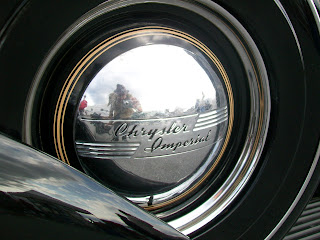
Much in the same way that people call Continental Marks of the 70’s through the early 80’s “Lincoln Continental Marks” even though they never said “Lincoln” on them, after all they were sold alongside “Lincoln Continentals” in Lincoln-Mercury Dealers, but such is the way things are in the world of automotive nomenclature. And I think it is much preferable to the alphabet soup of the present day “MKZ, MKS, etc.”. The Imperial was a distinctive, powerful, well engineered car, if not always well-built. Sales were never terribly high, although they did surpass Lincoln briefly in the late 50’s before Lincoln Continental seized the number 2 spot in the luxury market.
Imperials have several distinctive traits among their 20 years of independent marketing, the earliest cars are known for freestanding taillights, or taillights integrated with oversized flamboyant tailfins. In fact the quintessential Cadillac the outlandish 1959 Cadillac with its enormous fins and twin rocket pod taillights can be clearly read as a reaction against the 1957 Imperial. That the mighty Cadillac felt the need with its enormous production numbers to answer the challenge of the Imperial with its meager sales says a lot about the real style leader.
But it was of little consolation to the slow selling Imperial, which would end up following Lincolns slab side lead in 1964. The 1964 Imperial is largely a riff on the stunning 1961 Lincoln Continental, and it was designed by the same man, Elwood Engel.
Passed over for the head of styling at Ford on the heels of the exquisite Continental, Elwood ended up at Chrysler. Chrysler having set the tone for the late 50’s with its long low rakish designs and daring fins under the design of Virgil Exner , had stayed at the party too long, and Elwood was brought in to replace Exner and apply his signature shear, slab sided corner filled out design language to the entire Chrysler Corporation line. This “corner filled out” look would be the hallmark of all subsequent Imperials. Virgil Exner deserved better, he came along when Chrysler was dead last in the looks department and reinvigorated the stodgy cars with style and flair. Introduced gradually starting in 1955 Exner’s design language was called the “Forward Look”. It generally gave the cars a lower wedge like profile, with canted fronts and ends to denote motion.
Fins visually lifted the rears of the cars, each make in the Chrysler Corporation was given a signature fin, and the motif was developed over several years.
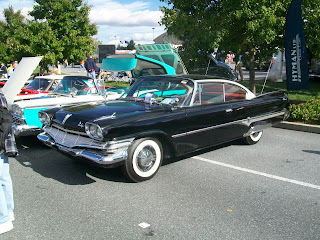
The Imperial trademark was daring fins with distinctive freestanding taillights, in some cases integrated with the fin or suspended or mounted on the fin. Sales followed across the line especially in 1957, unfortunately the production side of things was neglected and quality control was so bad that so many customers won over by the daringly beautiful cars were turned off by the horribly put together machines Exner would end up taking too much blame for things out of his control. Imperial never managed too many sales, perhaps there wasn’t enough distinction between the standard Chrysler line to justify the price premium. And although they were feature laden cars that performed superbly they lacked the prestige of other luxury cars, limiting their “snob appeal”. They have amazing attention to design detail, each medallion on the car is a mid-century work of art as is the script work on the name plates. The freestanding headlights are meant to recall classic automobiles of the 1930’s, and are suberb examples of retrofuturism.
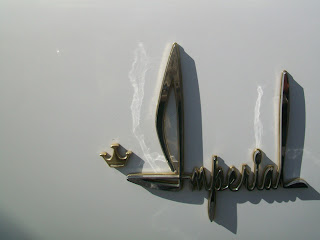
GM always had more sales, and I have soft spots for Oldsmobile and Buick but I have always thought that there were many more unique cars to be found at Ford and Chrysler. The famous Eldorado of 1967 owes more to the Continental Mark II than anything at GM. And the 59 GM lineup is an attempt to marry Exner’s finned Forward Look with the jet bomber bulbous motifs that were GM trademarks in the 50’s. The shear coke bottle look that was established by GM in the 60’s owes a lot to the slab sides and rear hop-up of the 61 Lincoln Continental. I was such a “Lincoln man” for many years I had a hard time fully embracing the Imperial, in fact my first car was a 1964 Lincoln Continental, and I also owned a 1969 Continental Mark III, and 87 and 96 Town Cars. But something about the quirky styling has called to the googie lover in me. The 57-62 Imperials really do have an out there retrofuturistic quality that I think is more Saarinen and Lautner-ish than say the Bauhaus feel of a 61 Lincoln Continental, and the 64-68 Imperials are Danish modern on wheels. So in many ways the Imperial won me over, much in the way the Populuxe/Googie style inspires me. I have never owned an Imperial, I came close but then the owner decided not to sell. It was a 67 Imperial Le Baron, and if the interior could have been sold on ebay they would have said “Eames L@@K!”, the seats looked like Eames chairs and the dashboard was like a Danish modern hi-fi cabinet. I have since owned a Chrysler LHS and a PT Cruiser, and I like them, but then they are more aspirational mid priced cars than true luxury cars and that was largely what did the Imperial in, they none the less have a bit of that American style that made Chryslers and Imperials so special.